








Production Processs
admin
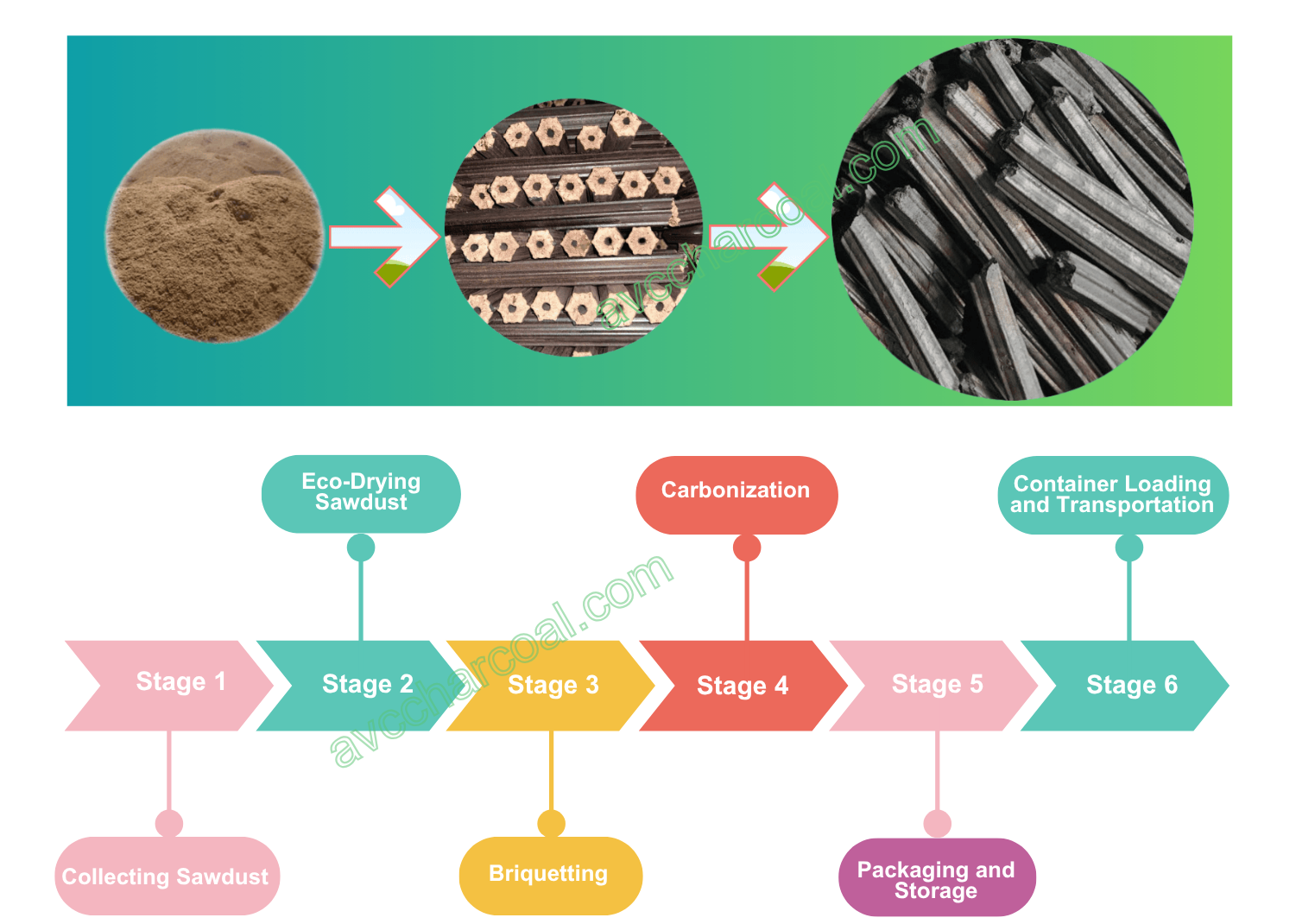
Production Process Flow Chart
The production of high-quality sawdust charcoal briquettes is a rigorous process that transforms raw wood by-products into premium, eco-friendly fuel. To ensure superior hardness, high calorific value, and smokeless performance, the manufacturing flow must adhere to strict technical standards at every turn. Our production line is optimized for sustainability and efficiency, utilizing advanced heat-recovery technologies to minimize environmental impact. Specifically, the transformation from raw sawdust to the finished export-grade charcoal involves the following six essential stages:
Stage 1: Collecting Sawdust
Our raw materials are sawdust, mainly by-products from other industries such as wood-processing factories and furniture workshops. They are collected from across the country, throughout Vietnam. We carefully select sawdust that meets our requirements for stability and cleanliness, ensuring consistent quality before it enters the next production stages. By using these renewable by-products, we reduce waste and make our production process more sustainable.
Stage 2: Eco-Drying Sawdust
Before compression, the sawdust must be dried to achieve an optimal moisture level, typically below 12%. This stage is essential for maintaining uniform density, preventing cracks, and ensuring high-quality charcoal briquettes. We call our drying process is Eco-Drying process because we do not fire wood to procure heat. We use a rotary drum drying system with exhaust gas recirculation technology. The heat source comes from broken briquettes, while the exhaust gas from the carbonization furnace — which contains CO and tar — is partially reused to improve energy efficiency and reduce emissions.
STAGE 3: Briquetting
The dried sawdust is conveyed by a belt system into extrusion briquetting machines, where it is compressed into hexagonal or square briquettes with a cross-section of about 5 cm × 5 cm and a length of 45–50 cm. With a system of up to 14 briquetting machines, we ensure high production capacity to meet the demands of our valued customers.
Stage 4: Carbonization
The molded briquettes are loaded into carbonization furnaces, where they are heated under controlled conditions with limited oxygen. During this process, volatile substances are released, and the briquettes are transformed into high-quality charcoal. The carbonization period lasts for about 12–14 days, ensuring uniform quality and a high carbon content. This stage plays a crucial role in determining the charcoal’s calorific value, hardness, and color. Our furnaces operate with an exhaust gas recirculation system, allowing us to reuse part of the exhaust — containing CO and tar — to improve energy efficiency and reduce emissions.
Stage 5: Packaging and Storage
After the products are completely cooled, they are packed into cartons with flexible weights according to customer requirements. Each carton is made of five-layer corrugated cardboard with an inner plastic liner for moisture protection. The finished goods are stored in a standard warehouse to ensure product quality and stability before delivery.
Stage 6: Container Loading and Transportation
We follow a professional 40HQ container loading process under the supervision of an independent inspection agency. During loading, the product temperature is checked to ensure safety, and each container is lined with fire-resistant tarpaulin and vacuum-sealed for maximum protection. We are committed to delivering high-quality, smokeless, and eco-friendly charcoal products to our customers worldwide.


Related news


Our Profile
AVC CHARCOAL COMPANY PROFILE High quality sawdust charcoal briquettes from Vietnam ...
Read more
Production Processs
Production Process Flow Chart The production of high-quality sawdust charcoal briquettes is a rigorous process that transforms raw wood by-products into premium, eco-friendly fuel. To ensure superior hardness, high calorific value,...
Read more


